
Medical emergency first
Airway or swallowing difficulty, spreading neck swelling, major trauma, severe systemic illness or uncontrolled bleeding requires emergency medical care rather than routine clinic scheduling.
Choose a topic to see what to expect and what to ask.
Third-party referral, not this office’s direct line. ApexTrusted may earn a fee and does not provide dental care. How referrals work
Arizona statewide dental guide | Reviewed October 29, 2026. Emergency dental care is not a single statewide appointment network. Where you live—from the Phoenix metropolitan area and Tucson to northern high-country communities, western Arizona and remote parts of the state—can affect travel, clinic hours and available treatment. This independent guide explains dental emergencies, Arizona provider verification, AHCCCS benefits, reduced-fee resources and the questions to ask before traveling. It does not imply that any listed office has an open appointment.
Guide scope: Independent statewide research and decision support, not a dental office or real-time appointment booking service. Verify each practice, plan rule and current cost before traveling.
Describe the symptom, timing and location; ask about a same-day assessment and treatment options.
Ask whether prior dental X-rays or records should be provided in advance.
Trouble breathing or swallowing, major facial trauma, uncontrolled bleeding or rapidly spreading swelling requires urgent assessment.
Call 911 or seek immediate medical emergency assessment for trouble breathing or swallowing, uncontrolled bleeding, major facial or jaw trauma, rapidly expanding facial or neck swelling, or serious illness accompanying a suspected infection. Do not wait for a dental appointment when these warning signs occur. A hospital emergency department may evaluate a dangerous complication, but definitive tooth treatment often requires a dentist.
For a severe toothache, suspected abscess without the medical warning signs above, cracked tooth, broken crown, painful wisdom tooth or a tooth knocked loose by an injury, call a dental office promptly. Explain the symptoms and timing; ask whether an appropriately qualified dentist can examine you that day, what services are offered at that exact location, and whether a referral might be needed. A search result labeled “emergency” or “24 hours” is not proof of a current opening.
Airway or swallowing difficulty, spreading neck swelling, major trauma, severe systemic illness or uncontrolled bleeding requires emergency medical care rather than routine clinic scheduling.
Persistent intense pain, localized swelling, a new fracture or a failed restoration with symptoms merits prompt assessment. Ask what the practice can treat and whether a same-day evaluation is possible.
Act immediately. Handle the crown, avoid damaging the root, keep the tooth moist when it cannot be replanted safely and seek urgent dental advice. Never replant a knocked-out baby tooth.
For a stable concern, cleaning or planned treatment, verify the dental network and seek a written estimate. A preventive-only hygiene clinic may not provide urgent treatment.
The American Association of Endodontists' dental trauma guidance distinguishes permanent-tooth emergencies from baby teeth and stresses rapid assessment. This guide cannot diagnose injuries or prescribe treatment.
The locator below identifies Arizona's geographic outline in the surrounding U.S. map; it is not a map of verified open dentists, appointment availability, provider quality or county-level dental rates. Use the regional notes to organize calls, then confirm addresses and treatment directly with the relevant office or health plan.
Phoenix and the East and West Valley: check several dental practices or community clinics, not just one search result; distinguish general, urgent and specialty appointments.
Tucson and southern Arizona: compare in-town options with regional community health centers and ask whether the chosen site provides the procedure you need.
Flagstaff and northern high country: confirm referral needs and travel time; snow or long-distance routes can affect access in some seasons.
Western, eastern and remote communities: ask about clinic days, transport, specialist referrals and whether an appointment must be scheduled before a long drive.
Geographic orientation only; no real-time office locations or fabricated practitioner pins.
search for a licensed general dentist, pediatric dentist, specialist or appropriate clinic depending on the patient's symptoms. A school hygiene clinic and a dental emergency practice do not offer the same services.
use the Arizona State Board of Dental Examiners' professional license search for dentists, hygienists, denturists and businesses. Verify the actual treating professional instead of relying solely on search-engine reviews.
call the office, confirm its street address, open hours and whether a dentist can evaluate the problem today. Ask if the office performs extraction, root-canal treatment, treatment for children, sedation or referral when needed.
for AHCCCS, use the plan's own member services or provider finder. Independently confirm the site accepts the patient's specific plan and new patients, and ask about prior authorization.
ask for an examination and imaging quote, itemized treatment options, estimated member responsibility and how a change in treatment will be authorized or billed.
Arizona call script: “I'm calling from Arizona ZIP code [ZIP] for [adult or child]. The symptom is [description] and started [time]. Can a dentist examine this today at your location? Do you treat this problem on site, accept [specific plan], and what is the exam and X-ray cost?”
For broader discovery, the American Dental Association's dentist finder can supplement the licensing search. Neither directory establishes same-day capacity, emergency hours or an active relationship with ApexTrusted.
Arizona's Medicaid program is the Arizona Health Care Cost Containment System (AHCCCS). Its public Programs and Covered Services listing distinguishes adult emergency dental coverage from the broader dental screening and treatment benefits for eligible members younger than 21. Benefits are not a blanket promise that every dentist, diagnosis or procedure is covered.
AHCCCS currently lists emergency dental services for adults age 21 and older up to $1,000 per contract year. AHCCCS's Fee-for-Service provider manual identifies the contract-year period as October 1 through September 30 for the general adult emergency benefit. The actual member's covered service, authorization, billing treatment, plan arrangements and any exceptions must be verified with the plan and treating provider. The $1,000 figure is a benefit limit, not a quoted treatment price, guaranteed reimbursement or personal cash allowance.
AHCCCS also publishes separate medical policy sections 310-D1 and 310-D2 for adult dental services and Arizona Long Term Care System (ALTCS) dental services. Some members or specific tribal-facility situations may be subject to distinct provisions; never assume a single rule covers everyone. Ask the plan to explain the applicable policy and remaining benefit.
For eligible AHCCCS members under age 21, Arizona describes routine dental services along with medically necessary care under the Medicaid child preventive and treatment framework. The state's Dental Coverage information sheet states that young members can receive routine and emergency dental care. The clinic still needs to verify eligibility, treatment necessity, network status and the precise plan rules.
Three questions to ask member services: “Is this procedure a covered dental emergency for my enrollment category? Is the exact dentist and clinic in-network? What approval and out-of-pocket steps apply before the appointment?”
There is no verified statewide cash price for an “Arizona emergency dentist.” A first exam, radiographs, urgent stabilization, extraction, restoration, root canal, crown or specialist referral can produce very different bills. Published fees can exclude imaging, follow-up, complications or after-hours charges. Ask a clinic for a written, case-specific estimate after assessment whenever possible.
A reliable appointment plan is particularly useful when a clinic is far away, the patient is young, a specialty procedure may be necessary, or the office is not in the patient's regular insurance network.
note the tooth or area, injury time, swelling, fever, bleeding and any difficulty breathing or swallowing. Medical red flags need urgent medical care, not a delayed dentist callback.
ask for the physical address, arrival time, open hours, accessibility and the type of dentist who can assess the problem. Check the distance and transportation before traveling.
bring a medication list, allergies, relevant conditions and prior dental records or X-rays if the office requests them. Do not change prescribed medication based on an online article.
provide your plan/member details, confirm authorization or referral rules, and ask about exam fees and written treatment estimates.
ask what temporary treatment means, how pain or swelling should be monitored, whom to contact after hours and whether additional specialist care is required.
For a knocked-out permanent tooth, professional guidance emphasizes very fast dental evaluation and careful handling. Do not attempt to put a knocked-out baby tooth back into its socket. The American Heart Association/American Red Cross first-aid guidance explains appropriate first-aid steps for permanent-tooth avulsion.
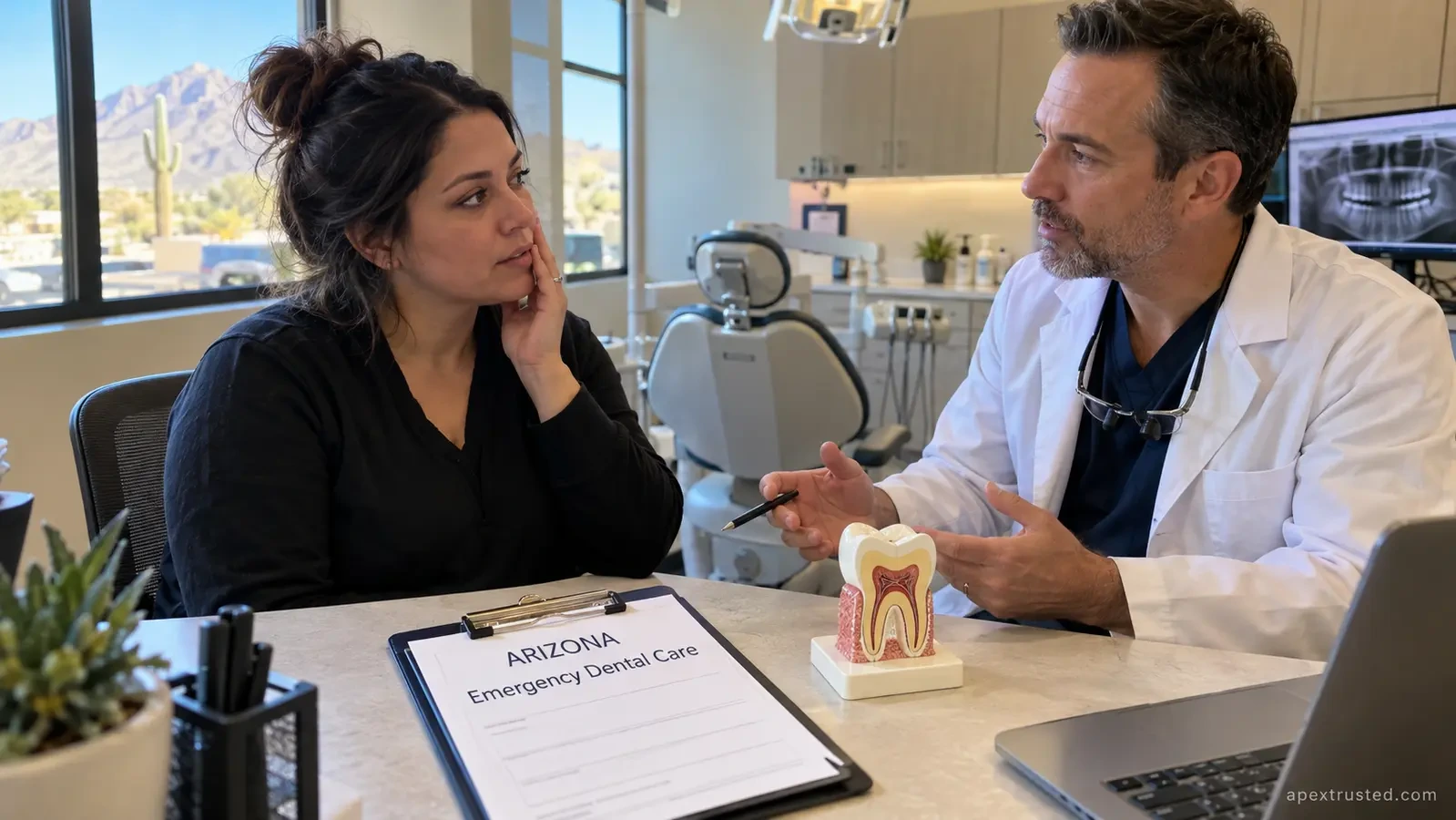
Evidence review: October 29, 2026. This state-level guide cites Arizona public agencies, its Medicaid program and professional first-aid guidance. It contains no purported verified office inventory, live appointment slots or individualized treatment estimates. All five accompanying images are AI-created editorial illustrations of possible Arizona dental-care situations, not photographs of identified providers, patients or services.
About ApexTrusted: This independent educational guide does not provide dental treatment, diagnose a condition, guarantee an appointment or represent a dental office. Arizona clinic eligibility, AHCCCS plan terms, fees and hours may change. Verify details directly with the insurer or treating practice. A phone or referral service, when offered separately, may connect callers to a third-party provider; confirm its relationship and any costs before agreeing to services.
State-specific answers about emergencies, coverage and finding care across Arizona.
No. Offices and clinics have different hours, treatment abilities and eligibility rules. Call a licensed provider serving your area for a dental issue, and call 911 for a life-threatening medical emergency.
AHCCCS lists emergency dental benefits for members age 21 and older up to $1,000 per contract year under the general rule. A member must verify the precise diagnosis, procedure, enrollment, network and applicable benefit period with the plan; this is not unlimited adult dental coverage.
The general Fee-for-Service manual describes a contract year from October 1 to September 30, not January through December. Check your particular plan or enrollment category for applicable provisions, current remaining benefits and any exceptions.
AHCCCS describes screening and treatment benefits for eligible members under age 21. The dentist and member services should confirm the specific dental plan, network, medical necessity and any approval requirements before treatment.
Use the ADHS reduced-fee/community dental directory and sliding-fee clinic resources as starting points. Ask the specific site about eligibility, current fees, services, appointment times and whether it treats urgent problems. A dental hygiene school may provide preventive care only.
Use the Arizona State Board of Dental Examiners' license search to verify a treating professional or business. A clinic advertisement or star rating is not primary-source license verification.
Some offices may offer urgent appointments, but availability changes and cannot be confirmed by this guide. Call the actual office, explain the symptoms, confirm the clinician and procedure, and ask about payment and network status before leaving.
Emergency departments assess serious injury, dangerous infection and other medical complications; definitive tooth repair may require a dental office or specialist. Follow discharge instructions and arrange dental follow-up.
Seek immediate dental guidance and identify whether the tooth is primary or permanent. Do not reinsert a knocked-out baby tooth. A permanent-tooth injury is time-sensitive; handle the crown and follow first-aid and professional advice.
No reader feedback yet for this guide — share what was useful or unclear.
This Arizona guide is general educational and directory information, not dental or medical advice. Same-day availability, fees, insurance participation, and clinical recommendations must be confirmed with the provider you contact.
If the page shows an affiliate dental phone number, that number is managed separately from the health-insurance phone channel. Calling may connect you with a third-party dental referral or scheduling partner.
ApexTrusted is a directory service and is not affiliated with any state dental board, insurance carrier, Medicaid, Medicare, or other government program.
Reader ratings concern the usefulness of this statewide guide, not the clinical quality of any dentist or clinic. Reviews are moderated but are not independently verified. ApexTrusted does not endorse the views expressed or guarantee their accuracy.