
Medical danger signs
Breathing or swallowing problems, major trauma, uncontrolled bleeding, spreading neck swelling or serious systemic illness: seek emergency medical care immediately.
Choose a topic to see what to expect and what to ask.
Third-party referral, not this office’s direct line. ApexTrusted may earn a fee and does not provide dental care. How referrals work
California statewide emergency dental guide | Reviewed October 29, 2026. Finding urgent care in California involves more than searching for a nearby practice. The state's size, its Medi-Cal Dental delivery systems, the kind of dental treatment needed and the difference between a dental appointment and a medical emergency all matter. This independent guide helps residents compare routes to care, confirm licensure, understand the 2026 benefits landscape and ask useful questions before they travel. It is not a directory of confirmed open appointments.
Guide scope: Independent statewide research and decision support, not a dental office or real-time appointment booking service. Verify each practice, plan rule and current cost before traveling.
Describe the symptom, timing and location; ask about a same-day assessment and treatment options.
Ask whether prior dental X-rays or records should be provided in advance.
Trouble breathing or swallowing, major facial trauma, uncontrolled bleeding or rapidly spreading swelling requires urgent assessment.
Call 911 or get immediate medical emergency assessment for difficulty breathing or swallowing, rapidly increasing swelling of the mouth, face or neck, major facial or jaw injury, uncontrolled bleeding or severe illness with a suspected infection. Do not wait for a dental callback when a life-threatening complication may be present. A hospital can assess serious medical problems, but definitive tooth treatment may still require a dentist.
For persistent severe tooth pain, a possible abscess without the medical danger signs above, a fractured tooth, painful wisdom tooth, broken filling or crown, or a tooth displaced by injury, call a licensed dental office promptly. State the exact symptoms, when they started and whether there is swelling or trauma. Ask whether a dentist at that location can evaluate the problem and what services are actually offered. The words “emergency dentist” or “open now” in a search result are not proof of same-day treatment.
Breathing or swallowing problems, major trauma, uncontrolled bleeding, spreading neck swelling or serious systemic illness: seek emergency medical care immediately.
Significant tooth pain, a painful crack, localized swelling or a failed restoration: call a dentist and explain the symptom and timing rather than booking an unverified routine cleaning slot.
A permanent-tooth avulsion is time-sensitive. Handle the tooth by its crown, avoid scrubbing the root, keep it moist when appropriate and seek immediate professional advice. Never replant a knocked-out baby tooth.
For nonurgent cleanings or treatment planning, compare coverage, access, written estimates and provider licensure before committing to a clinic.
The American Dental Association's dental emergency guidance and American Association of Endodontists' tooth injury guidance explain why trauma to permanent teeth needs quick advice. This article cannot diagnose pain, infection or injury or tell an individual patient to start or stop medication.
The shared locator displays California's real geographic outline in its U.S. context. It does not plot live dental offices, measure county care quality, rank dentists or estimate appointment wait times. Use the regions below to decide how far to widen a search, then verify exact addresses and available care directly.
Map for geographic orientation only. It contains no fabricated provider pins, prices or patient ratings.
For statewide discovery, the California Department of Public Health's oral-health service page lists established ways to locate services. The HRSA health-center locator helps identify additional community resources; check each site's dental scope.
an urgent general dentist, pediatric dentist, endodontist, oral surgeon, dental school or community health center serves different needs. A hygiene-only site cannot be assumed to treat acute injuries.
use the California Department of Consumer Affairs license search, linked from the Dental Board of California consumer page. The listing may show active, expired or disciplinary status; inspect the specific professional rather than relying on third-party stars.
ask whether the dentist can examine the problem today, whether the office takes new patients, whether the intended service is onsite and whether a specialist may be needed.
private dental insurance, Medi-Cal Dental Fee-for-Service and Medi-Cal Dental Managed Care networks can differ. Call the plan to confirm the exact office and any authorization rather than assuming a dental practice takes every Medi-Cal arrangement.
request examination/imaging pricing, likely next steps, payment method, referral requirements and the correct address and arrival time. Do not equate a quoted consultation with the total cost of treatment.
California phone script: “I am in California ZIP code [ZIP]. The patient is [adult/child] and has [symptoms] since [time]. Can a licensed dentist evaluate this urgently at your actual office? Do you offer the likely treatment, accept [specific plan or Medi-Cal dental arrangement], and what are the initial exam and X-ray charges?”
If a private office declines a plan or cannot provide care, use the official Medi-Cal Dental contact information or the HRSA health-center service finder to broaden the search. Neither source guarantees a dentist, appointment or service at a particular time.
Medi-Cal Dental is California's public dental benefit for eligible Medi-Cal members; it is distinct from an ordinary private dental policy. DHCS currently describes examinations, X-rays, cleanings, emergency pain control, extractions, fillings, qualifying root canals, crowns, gum treatment, dentures and qualifying pediatric orthodontic services. Coverage depends on the member's eligibility, age, clinical criteria, provider/network and service-specific authorization. A service appearing on a program list is not proof that one person's proposed procedure is covered.
Medi-Cal dental services generally operate through the Fee-for-Service system. Use the official member help line and provider directory to locate an enrolled dentist, then call the office.
DHCS describes a voluntary managed dental plan option alongside Fee-for-Service. Confirm the member's actual arrangement and provider network before scheduling.
DHCS describes Dental Managed Care as generally mandatory, subject to specific exceptions. Plan network and access processes matter. Confirm the current enrollment with member services.
The DHCS Medi-Cal Dental member service line is (800) 322-6384. This is a published California program number, not an ApexTrusted referral or a direct dental office number.
The official DHCS managed-care overview and Dental Managed Care plan directory publish the relevant systems and plan contacts. Where plan enrollment is unclear, call DHCS or the plan directly instead of assuming a public online listing reflects a current member's assignment.
As of October 29, 2026, DHCS states that certain adult Medi-Cal Dental benefit restrictions have been delayed until July 1, 2027. The changes concern some adults aged 19 and older whose immigration status does not qualify them for federally funded full-scope Medi-Cal, with important exceptions. Restricted-scope members can have emergency-related coverage; others may continue full-scope dental under their eligibility category. Do not label all California adult Medi-Cal dental care as emergency-only in 2026.
Use the current agency notices, not an old date: DHCS Dental Benefit Changes and its official FAQs document the July 1, 2027 delay and eligibility exceptions. The October 2026 Medi-Cal Dental Provider Handbook describes service limitations and payment rules. Program materials may change; verify directly with DHCS before relying on the article for an upcoming visit.
Ask member services: “What dental benefits does this California member have today? Are we in Fee-for-Service or Dental Managed Care? Is the proposed urgent service covered, does it need approval, and where is the nearest enrolled dentist accepting this patient?”
There is no reliable single statewide “emergency dentist price.” An exam or X-ray charge can differ from stabilization, extraction, root canal, crown, sedation, specialist care or return visits. Treatment recommendations follow a clinician's evaluation, and an advertised initial fee can omit other necessary steps. Private dental plans can have deductibles, annual limits, waiting periods, exclusions, network rules and different emergency coverage. Do not confuse a program reimbursement schedule with a patient's actual bill.
HRSA explains that participating health centers may charge on a sliding scale according to the patient's ability to pay; the exact dental discount and service availability must be verified with the site. See HRSA's Get Health Care page. This guide does not present any invented cash price, advertised opening or discount promise.
A few details reduce the risk of reaching the wrong clinic, particularly when a Californian must cross a county boundary, use a managed-care network or locate pediatric or specialty care.
record when pain or injury started, the affected area, swelling, fever, bleeding and any breathing or swallowing difficulty. Medical danger signs call for immediate emergency care.
verify the exact address, treating clinician, hours, age restrictions and whether an urgent evaluation is available. Don't rely on generalized 24-hour search labels.
bring the member card or other enrollment details, ask whether the office takes your precise Medi-Cal dental system or private plan and confirm referral or authorization rules.
bring a current medication list, allergies, relevant medical conditions and any requested dental images or records. Do not change prescriptions based on web content.
ask about exam/imaging, possible stabilization, definitive treatment, specialist referrals, care instructions and after-hours contacts. Request an itemized explanation when possible.
Tooth injury note: a knocked-out permanent tooth needs immediate professional attention. Handle the crown carefully and avoid root damage; do not replant a baby tooth. Follow AAE guidance and the American Heart Association/Red Cross first-aid guidance while arranging urgent help.
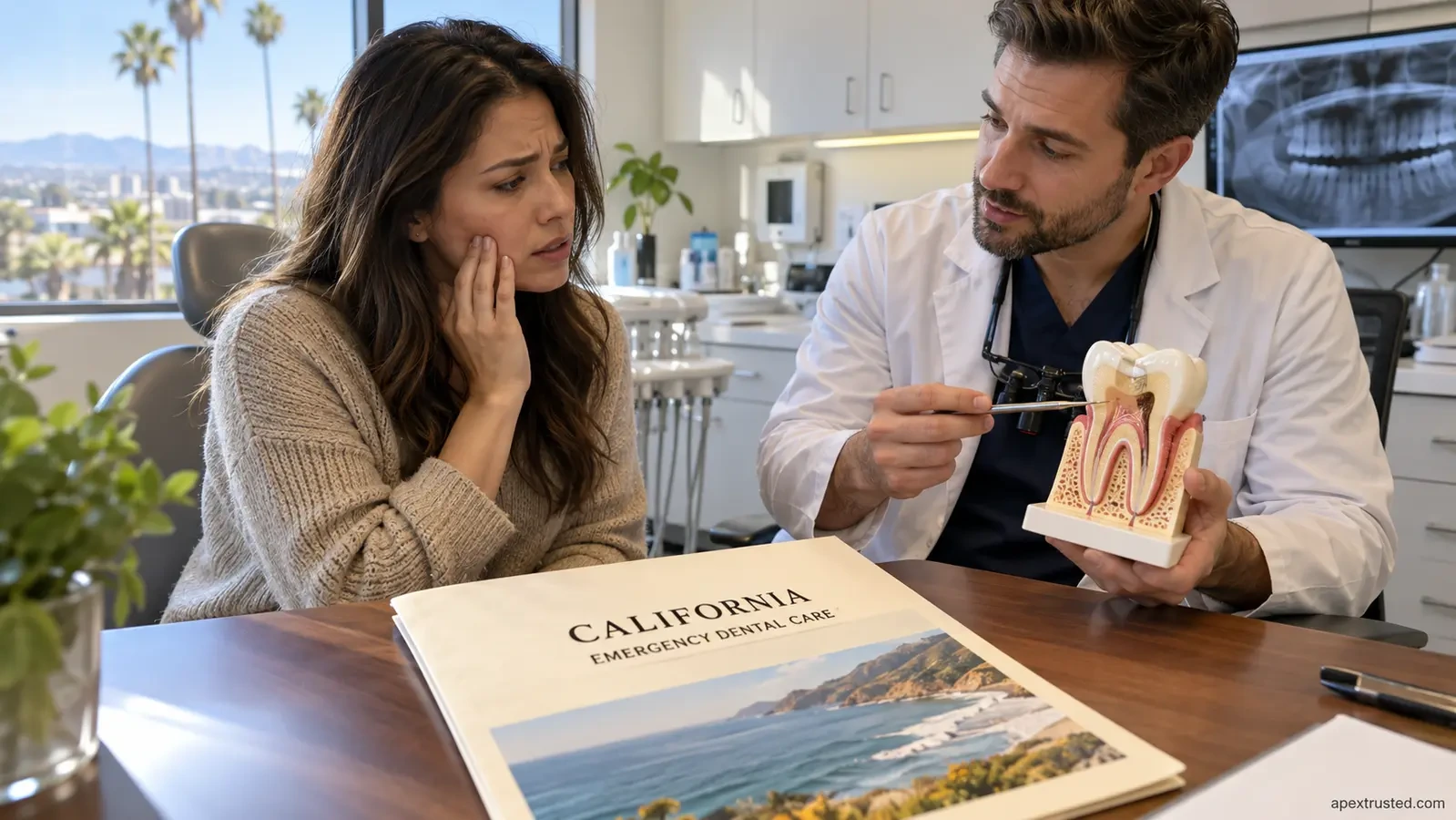
Reviewed October 29, 2026. This independent guide relies on California DHCS, the Dental Board/DCA, CDPH, HRSA and dental emergency/first-aid organizations. Policy and clinic directories may update. No provider inventory, current same-day slots, ratings, individual patient eligibility or quoted prices were independently verified. Five AI-created images are illustrative editorial photographs, not real clinics, actual dentists or evidence of a patient's care. This State guide's own review form invites feedback on the usefulness of this information, not a rating of a dentist.
Independent publication disclosure: ApexTrusted does not diagnose or treat patients, guarantee a specific appointment or represent a named dental office. Insurance eligibility, dental benefits, fees, clinic hours and procedures should be confirmed directly. If a separate referral phone service is offered, it may connect to a third-party provider and may compensate ApexTrusted; a referral number is not a dental office's direct contact.
State-specific answers about emergencies, coverage and finding care across California.
DHCS lists emergency services for pain control among Medi-Cal Dental benefits. Actual coverage depends on eligibility, the proposed service, clinical criteria and the member's dental delivery system. Confirm with DHCS, the plan and the dentist; not every office or procedure is automatically covered.
No. The DHCS restrictions target specified adult eligibility categories, not all adult members. Some newly enrolled restricted-scope adults have emergency coverage in 2026, while DHCS delayed broader changes affecting some existing members until July 1, 2027. Review the official FAQs for the person's exact status.
DHCS says the changes affecting some existing adults were delayed to July 1, 2027. Separate changes to eligibility for some new adults began January 1, 2026. The date and impact depend on immigration status, age, pregnancy/postpartum and foster-youth exceptions; member services should verify.
No. DHCS describes optional Dental Managed Care in Los Angeles County and generally mandatory Dental Managed Care in Sacramento County, subject to eligibility and exceptions. Fee-for-Service and specific plan providers differ. Verify the patient's enrollment and participating dentist before booking.
The 2026 provider handbook describes a calendar-year soft cap for certain non-exempt adult services, with medically necessary procedures and other exceptions. It is not an across-the-board out-of-pocket cap or guarantee. Ask the member service line and treating dentist how the applicable benefit and billing criteria work for the patient.
Use the California DCA License Search, reached from the Dental Board's consumer resources. Verify the treating dentist's status; a review-site rating does not replace this verification.
Start with HRSA's health-center finder and CDPH's oral-health service directory. Ask each exact site about dental services, sliding-fee eligibility, required documents, urgent treatment, appointments and referral restrictions. These resources do not establish an available slot or guaranteed discount.
A hospital emergency department can evaluate serious medical complications such as dangerous facial infection or major trauma. Definitive tooth repair commonly requires a dentist or specialist. Follow medical discharge instructions and arrange dental follow-up.
Seek professional dental advice immediately. A knocked-out permanent tooth is time-sensitive; handle it by the crown and keep it appropriately moist if it cannot be safely repositioned. Do not replant a knocked-out primary/baby tooth. Consult professional first-aid guidance.
No reader feedback yet for this guide — share what was useful or unclear.
This California guide is general educational and directory information, not dental or medical advice. Same-day availability, fees, insurance participation, and clinical recommendations must be confirmed with the provider you contact.
If the page shows an affiliate dental phone number, that number is managed separately from the health-insurance phone channel. Calling may connect you with a third-party dental referral or scheduling partner.
ApexTrusted is a directory service and is not affiliated with any state dental board, insurance carrier, Medicaid, Medicare, or other government program.
Reader ratings concern the usefulness of this statewide guide, not the clinical quality of any dentist or clinic. Reviews are moderated but are not independently verified. ApexTrusted does not endorse the views expressed or guarantee their accuracy.