
Medical emergency
Airway trouble, uncontrolled bleeding, major trauma, rapidly spreading swelling or severe illness means immediate medical help.
Choose a topic to see what to expect and what to ask.
Third-party referral, not this office’s direct line. ApexTrusted may earn a fee and does not provide dental care. How referrals work
District of Columbia emergency dental guide | Editorial review: November 3, 2026. Dental pain, a lost restoration or an injured tooth can require prompt professional assessment. This independent guide covers the District of Columbia as a single jurisdiction: medical warning signs, an accurate D.C. locator, access across city neighborhoods, how to check a dentist's license, the 2026 DC Medicaid and Healthy DC Plan distinction, dental care for children, lower-fee clinics, treatment estimates and practical calls to make. It does not book appointments or diagnose patients.
Guide scope: Independent statewide research and decision support, not a dental office or real-time appointment booking service. Verify each practice, plan rule and current cost before traveling.
Describe the symptom, timing and location; ask about a same-day assessment and treatment options.
Ask whether prior dental X-rays or records should be provided in advance.
Trouble breathing or swallowing, major facial trauma, uncontrolled bleeding or rapidly spreading swelling requires urgent assessment.
Call 911 or seek emergency medical assessment now if a dental or oral problem is accompanied by difficulty breathing or swallowing, uncontrolled bleeding, serious injury to the face or jaw, rapidly progressing facial or neck swelling, or serious systemic illness. These can be medical emergencies. An emergency department can evaluate dangerous complications but typically cannot replace definitive dental work such as a root canal or full restoration.
For an intense toothache, a cracked tooth, a lost filling or crown causing significant pain, a gum swelling, or an injured permanent tooth without those medical warning signs, call a licensed dental office promptly. Tell staff exactly when the problem began and whether fever, trauma, facial swelling, continuing bleeding or a child is involved. The dentist—not a listing or this article—determines the appropriate urgency, examination and treatment.
Airway trouble, uncontrolled bleeding, major trauma, rapidly spreading swelling or severe illness means immediate medical help.
Severe localized pain, a fractured tooth or new localized swelling calls for an actual dental triage conversation and an appointment confirmation.
Act quickly. Hold by the crown, not the root; avoid scrubbing; call an emergency dentist for time-sensitive handling guidance. Never replant a knocked-out baby tooth.
Ask the treating office for its actual after-hours instructions; a provider directory, nurse line or referral advertisement is not a guaranteed dental slot.
See the American Dental Association's dental-emergency guidance and the American Association of Endodontists' traumatic-injury guidance for general first-aid principles. Do not treat a website symptom list as a diagnosis, a prescription or a promise that a specific tooth can be saved.
The District of Columbia is a single federal district, not a state with counties. Its eight wards, four familiar geographic quadrants and adjacent Maryland and Virginia suburbs are relevant to travel, but they do not establish dental provider quality or availability. The locator below highlights the District in the national map; it does not show offices, verified open appointments, transit times or clinical outcomes.
Why wards matter: access planning in this compact urban jurisdiction involves bus/Metro travel, accessibility, work hours and the site where a dentist actually practices. A District map should never invent county boundaries or pretend to show live treatment-capacity pins. For the latest participating providers use the DC Medicaid online portal and provider directory, the District of Columbia Dental Society's reduced-fee care directory, and HRSA Find a Health Center. Treat all directories as starting points requiring a call.
First establish which benefit or insurance you actually have. D.C. Medicaid fee-for-service (FFS), a DC Healthy Families managed care plan, the Healthy DC Plan, employer dental insurance and self-pay are different coverage arrangements. Ask the member service line or provider directory for a currently participating dentist who treats the patient's age group and dental concern. An insurance logo on a clinic's web page does not prove the exact clinician, office and planned service are in network.
Then verify the clinician. DC Health says its online professional-license lookup is drawn from its licensing database and refreshed daily. The District Board of Dentistry regulates dentists and relevant dental professionals. A currently valid license does not mean the dentist can accept an emergency patient, has hospital privileges, treats children or accepts Medicaid.
report pain, swelling, injury, fever, age and timing. Ask whether it can evaluate or perform the likely procedure at that site.
request dentist name, office address, network participation, exam/X-ray charges and whether authorization or specialist referral applies.
a community health center may have medical, dental and after-hours triage schedules that differ; do not rely on a generic organization-hours snippet.
if the first dental clinic cannot treat the problem, ask for a named referral and confirm that receiving location before traveling.
DC Health verification provides the current source for checking a provider's license in the District.
The October 19, 2026 DHCF FFS handbook lists a Dental Helpline: 866-758-6807, Monday–Friday, 8 a.m.–5 p.m. Check current instructions if your coverage is managed care.
The official Medicaid member portal gives access to provider lookup. It advises members to confirm acceptance before treatment.
The D.C. Department of Health Care Finance's Medicaid Fee-for-Service Member Handbook, updated October 19, 2026, explicitly describes dental benefits for FFS members, a primary dental provider, dental appointments and services that may require prior authorization. It directs members to the dental helpline and participating providers. Benefit details depend on enrollment category, medical necessity, procedure and the actual delivery system: FFS rules should not be mechanically applied to every managed-care enrollee.
Crucial 2026 distinction: D.C. introduced the Healthy DC Plan as a separate Basic Health Plan for some residents no longer eligible for Medicaid. The District's published benefit comparison says adult dental is an example of a Medicaid benefit not covered under the Healthy DC Plan. Therefore, a Healthy DC Plan medical card should not be assumed to pay for a routine dental visit, even if a clinic participates in both medical arrangements. Check current plan documents for any separately purchased dental coverage or exceptions.
Current DHCF FFS handbook describes dental care, a dental help line, provider choices and some prior-authorization categories. Confirm the exact covered service with the treating dentist.
For a member in a District managed-care plan, use that plan's current dental network, member handbook and preapproval pathway rather than the FFS document alone.
A separate 2026 basic medical plan. The District says adult dental is not among its covered benefits. Do not rely on the plan's emergency medical benefit as proof that dental procedures are covered.
Published government summaries can differ in how they describe adult dental services. For example, an older DC Healthy Families summary uses a short description of emergency dental for adults, while the updated 2026 FFS handbook includes a more detailed dental pathway. Read the current, plan-specific benefit schedule and 2026 handbook for the particular patient's coverage rather than converting either broad summary into a universal promise about cleanings, fillings, dentures or oral surgery.
There were also Medicaid eligibility changes effective January 1, 2026. Program eligibility, whether a person is enrolled in FFS or managed care, and the procedure-specific dental benefit are separate questions. Confirm all three with the District or the member's plan. A Medicaid benefit amount is not a clinic price or a cash payment to the patient.
The District's Medicaid managed-care explanation identifies Early and Periodic Screening, Diagnostic, and Treatment (EPSDT) protections for eligible children under 21, including medically necessary services as defined by federal Medicaid rules. The DHCF managed-care overview identifies AmeriHealth Caritas DC and MedStar Family Choice DC for DC Healthy Families and Health Services for Children with Special Needs (HSCSN) for the CASSIP program. Some children are in FFS. Call the actual child's plan or FFS Dental Helpline to identify pediatric dental providers and the correct approval pathway.
DC Health also operates a school-based oral health program focused on preventive dental care; that is not the same as emergency treatment for an injured tooth. For a child with dental trauma, report the child's age, whether the tooth is a baby or adult tooth, the time of injury, bleeding, pain and any head injury. Do not reinsert an avulsed primary (baby) tooth. A knocked-out permanent tooth is time sensitive—seek professional dental instructions immediately. Serious trauma or airway signs need emergency medical care.
Ask the receiving practice whether it treats children of that age, can evaluate an injury that day, offers radiographs and can refer to pediatric dental or oral-surgery services when needed. Do not interpret an EPSDT entitlement as a guarantee that every local provider has open same-day appointments.
D.C. residents without dental coverage may have several starting points, but **each office's accepted patient ages, dental-site address, urgent capacity and fee rules must be reconfirmed**. The District of Columbia Dental Society publishes a directory of reduced-fee/free options, and the District's Office of Disability Rights lists additional possibilities. These are contact leads, not live appointment inventories or verified full-treatment price quotes.
Unity's dental program lists services at multiple D.C. health centers, including preventive care, restorations, extractions and dental referrals. Main appointment line: 202-469-4699. Its dental page describes same-day services, but an individual patient must verify actual site, age, timing and clinical scope.
Its current emergency dental page describes urgent assessments and possible same-day appointments. Main line: 202-745-7000. Confirm the receiving dental office, appointment, accepted insurance or sliding-fee terms before visiting.
The Dental Society's local directory lists its Fort Totten and Petworth dental resources. Contact the organization directly to verify which location is currently offering dentistry, eligibility and an urgent examination.
The D.C. Office of Disability Rights lists the teaching-clinic resource at 600 W Street NW, Washington, DC 20001, with 202-806-0008. Ask about triage, supervised-student care, new-patient requirements, urgency and fees; a university teaching clinic is not a walk-in ER guarantee.
Additional documented D.C. leads in the Dental Society directory include Bread for the City, Community of Hope, SOME and other community clinics. A provider's presence in that list does not establish that emergency dental slots, oral surgery, pediatric appointments or free treatment are available on the date you need care. Ask whether the proposed care is onsite, how appointments are prioritized and whether patients living outside D.C. are eligible.
There is no responsible single quote for “emergency dental care in District of Columbia.” Examination, imaging, temporary pain management, extraction, root canal, crown, specialist surgery and subsequent restorative work have very different billing and clinical requirements. The procedure is determined after evaluation, so the first telephone estimate may not be the total bill. Medicaid covered benefits and uninsured clinic prices are different concepts.
Ask for a written, itemized estimate when circumstances allow, separating evaluation, radiographs, the planned procedure, anesthesia/sedation where applicable, lab expenses, temporary restoration, medications, referral and follow-up. Check that the clinician, facility and treatment code participate in the patient's particular coverage—not just that the clinic accepts an insurer generally. Ask who submits any required preauthorization and whether the receiving practice will call if a service is not covered.
Use the current DHCF handbook, the dentist and the FFS Dental Helpline to confirm covered care and whether the proposed dental service needs authorization; do not assume self-pay or a copied online estimate.
Call the plan named on the member card, verify network location, adult or pediatric benefit, procedure restrictions and referral rules.
The District's comparison identifies adult dental as excluded from the separate plan. Request written confirmation of any other dental benefit or additional insurance before proceeding on an assumption of coverage.
Ask what income documents are needed, whether the first evaluation is discounted, what the full proposed procedure costs, and whether financing carries interest or separate terms.
Useful 2026 FFS detail: DHCF's October 19 handbook describes no routine beneficiary service charge for medically necessary covered FFS services and lists certain dental procedures among services that can require prior authorization. This wording does not eliminate all eligibility, network, documentation or coverage limits for every service. Ask before the procedure rather than relying on a blanket “free dentist” claim. When a medical emergency is developing, emergency escalation comes before shopping for a detailed price quote.
Bring a photo ID if available, current insurance or Medicaid identification, any relevant medication/allergy details, symptom chronology and prior dental records that are easy to access. If a child is involved, tell staff the age and type of tooth involved. Confirm that the location you have is a **dental clinic**, not merely the organization's administrative or primary-care building.
check for the red-flag medical symptoms above; record onset, swelling, trauma and treatment already received.
ask about age limits, emergency triage, dental hours, address, actual clinician, diagnostic services, insurance participation and evaluation charge.
request an explanation of the findings, options, risks, any necessary specialist referral and a clear estimate of patient responsibility.
follow the professional's directions, keep follow-up and referral details, and seek urgent medical help for worsening severe swelling, swallowing or breathing problems or uncontrolled bleeding.
Transportation/accessibility: the 2026 D.C. Medicaid FFS handbook lists a non-emergency transportation broker at 866-796-0601 and explains lead times and eligibility for non-emergency rides. It also describes interpretation and access assistance. Those benefits are for eligible FFS members under applicable rules and are not a replacement for calling 911 in an emergency. Verify instructions with the member's current plan if enrolled through managed care.
Screen for medical warning signs first. Otherwise, ask a licensed dental office or a current plan participating-provider directory about the specific dental complaint, age group, appointment time, clinician and location. A directory cannot guarantee a same-day slot.
The District's October 19, 2026 FFS Medicaid handbook describes dental services, a dental helpline and possible authorization requirements. Whether the specific treatment is covered depends on the member's eligibility, FFS versus managed care arrangement, medical necessity, dentist and procedure. Confirm individually.
The District's published comparison explicitly lists adult dental among benefits Medicaid covers but Healthy DC Plan does not. Verify current plan documents and any separate dental insurance instead of treating a medical plan as a dental policy.
The current DHCF FFS handbook lists 866-758-6807, Monday through Friday from 8 a.m. to 5 p.m. For managed care, use the member-services number on the actual plan card or current plan site.
No. The District is one jurisdiction with eight wards and well-known quadrants. Its map here is a geographic locator without fictional county boundaries, emergency queues or clinic pins.
The District of Columbia Dental Society maintains a reduced-fee/free care directory. Unity Health Care, Whitman-Walker Health, Mary's Center and the Howard University teaching clinic are possible leads; each site must confirm actual dental service, income requirements, fees and urgent capacity.
Start with DC Health's online professional-license verification portal and Board of Dentistry guidance. A license check and insurance network check are separate, and neither guarantees an open appointment.
Eligible children under 21 have EPSDT protections for medically necessary services. The pathway may be managed care or FFS, so use the child's actual plan or FFS resource to find participating pediatric dental care and verify approvals.
Get emergency medical help for breathing or swallowing difficulty, uncontrolled bleeding, serious facial trauma, rapidly spreading facial/neck swelling or severe illness. Otherwise call a dentist for localized dental pain; hospital treatment may not provide definitive dental repair.
No. Some centers advertise dental appointments or same-day services, but actual eligibility, patient share, clinician staffing, procedure capability and appointment openings need confirmation from that receiving dental location.
Ask whether the price covers an examination only or the complete proposed procedure; separate imaging, anesthesia, labs, referrals and follow-up. Verify provider network, prior authorization and any written estimate before non-emergency treatment when possible.
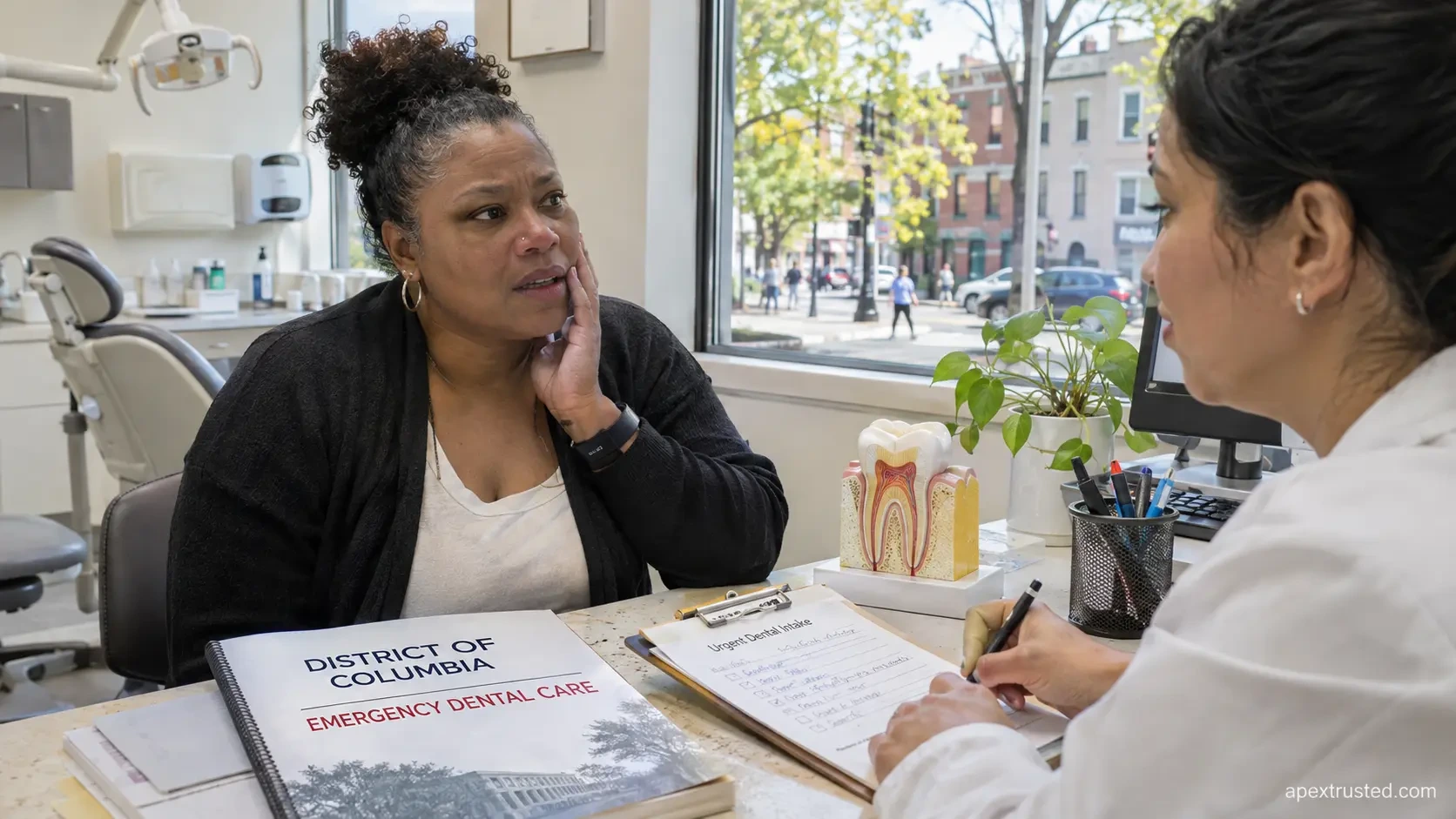
Editorial method: This independent statewide-jurisdiction guide was researched against primary D.C. government, professional licensing, healthcare provider and clinical-education sources on November 3, 2026. It does not rank practices, report fabricated patient reviews, measure live emergency dental waits or claim any organization endorses ApexTrusted. Photographs are independent AI-generated illustrations and do not identify actual clinicians, patients or facilities. All service availability, participating plans, patient eligibility, direct numbers and fees should be rechecked at the source before use.
Advertising and referral transparency: ApexTrusted does not provide treatment or guarantee that a paid phone referral reaches a particular dental office. The website's separately labeled referral number is not a substitute for the independently verified provider-specific numbers above. Review our Advertising & Referral Disclosure. Reader ratings on this page describe the usefulness of this guide only; they are not reviews of dentists, clinics or dental outcomes.
State-specific answers about emergencies, coverage and finding care across District of Columbia.
No reader feedback yet for this guide — share what was useful or unclear.
This District of Columbia guide is general educational and directory information, not dental or medical advice. Same-day availability, fees, insurance participation, and clinical recommendations must be confirmed with the provider you contact.
If the page shows an affiliate dental phone number, that number is managed separately from the health-insurance phone channel. Calling may connect you with a third-party dental referral or scheduling partner.
ApexTrusted is a directory service and is not affiliated with any state dental board, insurance carrier, Medicaid, Medicare, or other government program.
Reader ratings concern the usefulness of this statewide guide, not the clinical quality of any dentist or clinic. Reviews are moderated but are not independently verified. ApexTrusted does not endorse the views expressed or guarantee their accuracy.